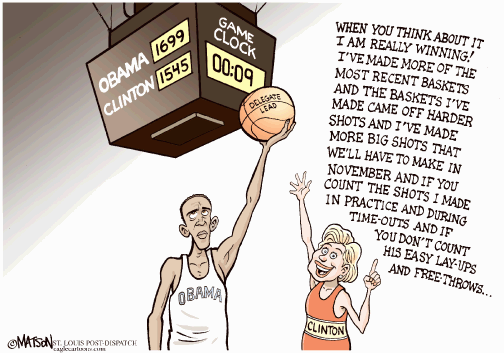
Originally posted at: http://www.caglepost.com/cartoon/RJ+Matson/50377/Hillary+Is+Really+Winning-COLOR.html
Having Fun
Originally posted at: http://www.caglepost.com/cartoon/RJ+Matson/50377/Hillary+Is+Really+Winning-COLOR.html
I hate the RIAA. They are greedy and trying to support a dying industry. It’s silly to think that they have won in court the right to charge someone $9,000 per song ripped, when it only costs $1 on i-Tunes. Stupidity.
By Nate Anderson | Published: January 29, 2008 – 09:57PM CT
Not content with the current (and already massive) statutory damages allowed under copyright law, the RIAA is pushing to expand the provision. The issue is compilations, which now are treated as a single work. In the RIAA’s perfect world, each copied track would count as a separate act of infringement, meaning that a copying a ten-song CD even one time could end up costing a defendant $1.5 million if done willfully. Sound fair? Proportional? Necessary? Not really, but that doesn’t mean it won’t become law.
The change to statutory damages is contained in the PRO-IP Act that is currently up for consideration in Congress. We’ve reported on the bill before, noting that Google’s top copyright lawyer (and the man who wrote a seven-volume treatise on the subject of copyright law), William Patry, called the bill the most “outrageously gluttonous IP bill ever introduced in the US.”
Very good article in the New York Times written by a pilot on the ludicrous security tactics employed by airports.
While there are some people I would love to use this on, it is really bad. Basically the article talks about this lovely device, that is illegal in the US, that will overwhelm all cell phones in the area and make them drop their calls and not be able to receive calls. Meanwhile in Toronto the subway is debating on having cell service in their stations and along the subway line so users can make/receive calls while traveling on the subway.  Some people want their commute in silence, however not all people partake in the SCREAM INTO THE PHONE SO YOU CAN HEAR YOURSELF BECAUSE YOU THINK THE OTHER PERSON CAN’T HEAR YOU type of conversation.
Do you care? Do you want to have cell service in the subway?
http://baltimorechronicle.com/2007/051107Lindorff.html
What is it about impeachment that has the Democratic Party leadership so frightened? Talking with members of Congress, one hears the same refrain: “I know Bush and Cheney have committed impeachable crimes, but impeachment is a bad idea.â€
The rationales offered are many, but all are either specious or based upon flawed reasoning. Let’s consider them separately:
Excuse one, offered by Speaker Nancy Pelosi, is that impeachment would be a diversion from Democrats’ main goals of ending the Iraq War, and passing important legislation. The reality, of course, is that many of the administration’s impeachable acts relate directly to the war, so hearings would only build support for ending it. Meanwhile, with the slim majorities in both houses, Democrats cannot pass any significant progressive legislation that could survive a veto (or a presidential signing statement) and the record shows it. Excuse two is that impeachment is divisive. This seems the height of absurdity. When voters handed Congress to the Democrats, they knew they were setting the stage for divided government. That was the whole point. Moreover, divisiveness in Washington has largely emanated from the White House, not from Congress. Anyhow, given administration intransigence on all the issues that matter to Democrats, they have no alternative but to take a stand.
Excuse three is a claim that the public opposes impeachment. This is simply wrong. The few straightforward scientific polls done on impeachment, such as one published by Newsweek last October, show a majority of Americans to want it. Furthermore, if Bush has committed impeachable acts, it is inappropriate for House members, all of whom swore to uphold and defend the Constitution, not to act.
Excuse four is that old canard that impeaching Bush would mean making Cheney president—a deliberately scary prospect but one which any politician in Washington knows is garbage. Firstly, if Cheney were to become president because of a Bush impeachment or resignation, it would only be for a few months, and given his stunning lack of support among the public—currently about 9 percent and falling—he would be the lamest of lame ducks, unable to do anything. But more importantly, his own party would be certain to remove him before any removal of Bush, and for exactly that reason—they would not want to be going into the 2008 election with Cheney as party leader. This is exactly what happened to Spiro Agnew, whom a Republican attorney general managed to indict and remove before the collapse of Nixon’s presidency. The same thing can be expected to happen to Cheney, who would surely face either a sudden health crisis, or an indictment for corruption.
Finally, excuse five is that the president’s crimes and abuses of power need to be proven before any impeachment bill. This is completely backwards. An impeachment bill can be filed by any member of Congress who believes the president has violated the Constitution. At that point, it is up to the House Judiciary Committee to consider the bill’s merits and decide whether to ask the full House to authorize impeachment hearings. It is at an impeachment hearing where investigations should proceed. After all, only after the Judiciary Committee votes out an impeachment article can the full House consider whether to actually impeach. Calling for investigations before an impeachment hearing is like asking for an investigation before a grand jury investigation. It’s redundant, simply a dodge.
Besides, some of this president’s high crimes are self-evident. Take the case of Bush’s ordering the National Security Agency to spy on Americans’ communications without a warrant. A federal judge has already labeled this violation of the Foreign Intelligence Surveillance Act a felony. There is no denying this felony occurred, or that Bush is responsible. The only question the House needs to vote on is whether the felony is a “high crime†warranting impeachment.
The same applies Bush’s refusal to enact over 1200 laws or parts of laws duly passed by Congress. Bush doesn’t deny that he has usurped the power of the Congress, as laid down in Article I of the Constitution. Rather, he asserts—with no basis in the wording of that document—that as commander in chief in the war on terror, he has the “unitary executive†authority to ignore acts of Congress. Again, there is no need for an “investigation†to establish whether this happened. What Congress must do is decide whether this usurpation of its Constitutional role is an impeachable abuse of power.
Likewise the president’s authorization of kidnap and torture. We know the president okayed torture. We know too, that he used his “unitary executive†claim to refuse to accept a law passed overwhelmingly by the last Congress outlawing torture. Finally, we know the president did not, as required by US and international law, act to halt torture and punish those up the chain of command who oversaw systematic, widespread torture.
There are many impeachable crimes by this president (and vice president), such as obstruction of justice in the Valeria Plame outing case, conspiracy (or treason) in the Niger “yellowcake†document forgery scandal, conspiracy to engage in election fraud, lying to Congress, criminal negligence in responding to the Katrina disaster, bribery and war profiteering, etc., which would require Judiciary Committee investigations.
In the meantime, though, Democrats need to step up to their responsibility.
If this president is not to be impeached, Congress may as well amend the Constitution to remove the impeachment clause. It will, in that case, have become as much an anachronism as prohibition.
About the author: Philadelphia journalist Dave Lindorff is co-author, with Barbara Olshansky, of The Case for Impeachment: The Legal Argument for Removing President George W. Bush from Office
September 5, 2005 | 8:58 p.m. ET
The “city” of Louisiana (Keith Olbermann)
SECAUCUS — Secretary of Homeland Security Michael Chertoff said it all, starting his news briefing Saturday afternoon: “Louisiana is a city that is largely underwater…”
Well there’s your problem right there.
If ever a slip-of-the-tongue defined a government’s response to a crisis, this was it.
The seeming definition of our time and our leaders had been their insistence on slashing federal budgets for projects that might’ve saved New Orleans. The seeming characterization of our government that it was on vacation when the city was lost, and could barely tear itself away from commemorating V.J. Day and watching Monty Python’s Flying Circus, to at least pretend to get back to work. The seeming identification of these hapless bureaucrats: their pathetic use of the future tense in terms of relief they could’ve brought last Monday and Tuesday — like the President, whose statements have looked like they’re being transmitted to us by some kind of four-day tape-delay.
But no. The incompetence and the ludicrous prioritization will forever be symbolized by one gaffe by of the head of what is ironically called “The Department of Homeland Securityâ€: “Louisiana is a city…â€
Politician after politician — Republican and Democrat alike — has paraded before us, unwilling or unable to shut off the “I-Me” switch in their heads, condescendingly telling us about how moved they were or how devastated they were — congenitally incapable of telling the difference between the destruction of a city and the opening of a supermarket.
And as that sorry recital of self-absorption dragged on, I have resisted editorial comment. The focus needed to be on the efforts to save the stranded — even the internet’s meager powers were correctly devoted to telling the stories of the twin disasters, natural… and government-made.
But now, at least, it is has stopped getting exponentially worse in Mississippi and Alabama and New Orleans and Louisiana (the state, not the city). And, having given our leaders what we know now is the week or so they need to get their act together, that period of editorial silence I mentioned, should come to an end.
No one is suggesting that mayors or governors in the afflicted areas, nor the federal government, should be able to stop hurricanes. Lord knows, no one is suggesting that we should ever prioritize levee improvement for a below-sea-level city, ahead of $454 million worth of trophy bridges for the politicians of Alaska.
But, nationally, these are leaders who won re-election last year largely by portraying their opponents as incapable of keeping the country safe. These are leaders who regularly pressure the news media in this country to report the reopening of a school or a power station in Iraq, and defies its citizens not to stand up and cheer.
Yet they couldn’t even keep one school or power station from being devastated by infrastructure collapse in New Orleans — even though the government had heard all the “chatter” from the scientists and city planners and hurricane centers and some group whose purposes the government couldn’t quite discern… a group called The U.S. Army Corps of Engineers.
And most chillingly of all, this is the Law and Order and Terror government. It promised protection — or at least amelioration — against all threats: conventional, radiological, or biological.
It has just proved that it cannot save its citizens from a biological weapon called standing water.
Mr. Bush has now twice insisted that, “we are not satisfied,” with the response to the manifold tragedies along the Gulf Coast. I wonder which “we” he thinks he’s speaking for on this point. Perhaps it’s the administration, although we still don’t know where some of them are. Anybody seen the Vice President lately? The man whose message this time last year was, ‘I’ll Protect You, The Other Guy Will Let You Die’?
I don’t know which ‘we’ Mr. Bush meant.
For many of this country’s citizens, the mantra has been — as we were taught in Social Studies it should always be — whether or not I voted for this President — he is still my President. I suspect anybody who had to give him that benefit of the doubt stopped doing so last week.
I suspect a lot of his supporters, looking ahead to ’08, are wondering how they can distance themselves from the two words which will define his government — our government — “New Orleans.”
For him, it is a shame — in all senses of the word. A few changes of pronouns in there, and he might not have looked so much like a 21st Century Marie Antoinette. All that was needed was just a quick “I’m not satisfied with my government’s response.” Instead of hiding behind phrases like “no one could have foreseen,” had he only remembered Winston Churchill’s quote from the 1930’s. “The responsibility,” of government, Churchill told the British Parliament “for the public safety is absolute and requires no mandate. It is in fact, the prime object for which governments come into existence.”
In forgetting that, the current administration did not merely damage itself — it damaged our confidence in our ability to rely on whoever is in the White House.
As we emphasized to you here all last week, the realities of the region are such that New Orleans is going to be largely uninhabitable for a lot longer than anybody is yet willing to recognize. Lord knows when the last body will be found, or the last artifact of the levee break, dug up. Could be next March. Could be 2100. By then, in the muck and toxic mire of New Orleans, they may even find our government’s credibility.
Somewhere, in the City of Louisiana.
“CardSystems Exposes 40 Million Identities” as a harbinger? Now that
we know more about the facts in this recent case, expect more to come.
Yes, public opinion and credit card companies can and will force
companies that process credit card data to increase their security.
However, how about the “acceptable risk” concept that underlies the
very security procedures of credit card companies themselves and
pervades their relationships with their parties? Do As I Say, Not As
I Do?
The dirty little secret of the credit card industry is that they are
very happy with 10% of credit card fraud, over the Internet or not.
In fact, if they would reduce fraud to _zero_ today, their revenue
would decrease as well as their profits. So, there is really no
incentive to reduce fraud. On the contrary, keeping the status quo is
just fine.
This is so because of insurance — up to a certain level, which is
well within the operational boundaries of course, a fraudulent
transaction does not go unpaid through VISA, American Express or
Mastercard servers. The transaction is fully paid, with its
insurance cost paid by the merchant and, ultimately, by the customer.
“Acceptable risk” has been for a long time an euphemism for that
business model that shifts the burden of fraud to the customer.
Thus, the credit card industry has successfully turned fraud into a
sale. This is the same attitude reported to me by a car manufacturer
representative when I was talking to him about simple techniques to
reduce car theft — to which he said: “A car stolen is a car sold.”
In fact, a car stolen will need replacement that will be provided by
insurance or by the customer working again to buy another car. While
the stolen car continues to generate revenue for the manufacturer in
service and parts.
Whenever we see continued fraud, we should be certain: the defrauded
is profiting from it. Because no company will accept a continued
loss without doing anything to reduce it. Arguments such as “we don’t
want to reduce the fraud level because it would cost more to reduce
the fraud than the fraud costs” are just a marketing way to say that
a fraud has become a sale.
Because fraud is an hemorrhage that adds up, while efforts to fix it
— if done correctly — are mostly an up front cost that is incurred
only once. So, to accept fraud debits is to accept that there is
also a credit that continuously compensates the debit. Which credit
ultimately flows from the customer — just like in car theft.
What is to blame? Not only the twisted ethics behind this attitude
but also that traditional security school of thought which focus on
risk, surveillance and insurance as the solution to security problems.
There is no consideration of what trust really would mean in terms of
bits and machines[*], no consideration that the insurance model of
security cannot scale in Internet volumes and cannot even be
ethically justifiable.
“A fraud is a sale” is the only outcome possible from using such
security school of thought. Also sometimes referred to as
“acceptable risk” — acceptable indeed, because it is paid for.
Regards,
Ed Gerck
[*] Unless the concept of trust in communication systems
is defined in terms of bits and machines, while also making
sense for humans, it really cannot be applied to e-commerce.
And there are some who use trust as a synonym for authorization.
This may work in a network, where a trusted user is a user
authorized by management to use some resources. But it does
not work across trust boundaries, or in the Internet, with no
common reporting point possible.
PUT YOURSELF in Mike Bolesta’s place. On the morning of Feb. 20, he buys a new radio-CD player for his 17-year-old son Christopher’s car. He pays the $114 insta llation charge with 57 crisp new $2 bills, which, when last observed, were still considered legitimate currency in the United States proper. The $2 bills are Bo lesta’s idea of payment, and his little comic protest, too.
For this, Bolesta, Baltimore County resident, innocent citizen, owner of Capital City Student Tours, finds himself under arrest.
Finds himself, in front of a store full of customers at the Best Buy on York Road in Lutherville, locked into handcuffs and leg irons.
Finds himself transported to the Baltimore County lockup in Cockeysville, where he’s handcuffed to a pole for three hours while the U.S. Secret Service is call ed into the case.
Have a nice day, Mike.
“Humiliating,” the 57-year old Bolesta was saying now. “I am 6 feet 5 inches tall, and I felt like 8 inches high. To be handcuffed, to have all those people lo oking on, to be cuffed to a pole — and to know you haven’t done anything wrong. And me, with a brother, Joe, who spent 33 years on the city police force. It wa s humiliating.”
What we have here, besides humiliation, is a sense of caution resulting in screw-ups all around.
“When I bought the stereo player,” Bolesta explains, “the technician said it’d fit perfectly into my son’s dashboard. But it didn’t. So they called back and sa id they had another model that would fit perfectly, and it was cheaper. We got a $67 refund, which was fine. As long as it fit, that’s all.
“So we go back and pay for it, and they tell us to go around front with our receipt and pick up the difference in the cost. I ask about installation charges. T hey said, ‘No installation charge, because of the mix-up. Our mistake, no charge.’ Swell.
“But then, the next day, I get a call at home. They’re telling me, ‘If you don’t come in and pay the installation fee, we’re calling the police.’ Jeez, where d id we go from them admitting a mistake to suddenly calling the police? So I say, ‘Fine, I’ll be in tomorrow.’ But, overnight, I’m starting to steam a little. It ‘s not the money — it’s the threat. So I thought, I’ll count out a few $2 bills.”
He has lots and lots of them.
With his Capital City Student Tours, he arranges class trips for school kids around the country traveling to large East Coast cities, including Baltimore. He’s been doing this for the last 18 years. He makes all the arrangements: hotels, meals, entertainment. And it’s part of his schtick that, when Bolesta hands out m eal money to students, he does it in $2 bills, which he picks up from his regular bank, Sun Trust.
“The kids don’t see that many $2 bills, so they think this is the greatest thing in the world,” Bolesta says. “They don’t want to spend ’em. They want to save
’em. I’ve been doing this since I started the company. So I’m thinking, ‘I’ll stage my little comic protest. I’ll pay the $114 with $2 bills.'”
At Best Buy, they may have perceived the protest — but did not sense the comic aspect of 57 $2 bills.
“I’m just here to pay the bill,” Bolesta says he told a cashier. “She looked at the $2 bills and told me, ‘I don’t have to take these if I don’t want to.’ I sa id, ‘If you don’t, I’m leaving. I’ve tried to pay my bill twice. You don’t want these bills, you can sue me.’ So she took the money. Like she’s doing me a favor .”
He remembers the cashier marking each bill with a pen. Then other store personnel began to gather, a few of them asking, “Are these real?”
“Of course they are,” Bolesta said. “They’re legal tender.”
A Best Buy manager refused comment last week. But, according to a Baltimore County police arrest report, suspicions were roused when an employee noticed some s mearing of ink. So the cops were called in. One officer noticed the bills ran in sequential order.
“I told them, ‘I’m a tour operator. I’ve got thousands of these bills. I get them from my bank. You got a problem, call the bank,'” Bolesta says. “I’m sitting
there in a chair. The store’s full of people watching this. All of a sudden, he’s standing me up and handcuffing me behind my back, telling me, ‘We have to do t his until we get it straightened out.’
“Meanwhile, everybody’s looking at me. I’ve lived here 18 years. I’m hoping my kids don’t walk in and see this. And I’m saying, ‘I can’t believe you’re doing t his. I’m paying with legal American money.'”
Bolesta was then taken to the county police lockup in Cockeysville, where he sat handcuffed to a pole and in leg irons while the Secret Service was called in.
“At this point,” he says, “I’m a mass murderer.”
Finally, Secret Service agent Leigh Turner arrived, examined the bills and said they were legitimate, adding, according to the police report, “Sometimes ink on money can smear.”
This will be important news to all concerned.
For Baltimore County police, said spokesman Bill Toohey, “It’s a sign that we’re all a little nervous in the post-9/11 world.”
The other day, one of Bolesta’s sons needed a few bucks. Bolesta pulled out his wallet and “whipped out a couple of $2 bills. But my son turned away. He said h e doesn’t want ’em any more.”
He’s seen where such money can lead.
By JOE SHARKEY
Published: April 26, 2005
Everybody has a favorite story from what I think of as the T.S.A. Follies.
Here’s mine. A uniformed pilot waits impatiently at a checkpoint for 10 minutes while two screeners from the Transportation Security Administration scrutinize every item in his carry-on bag.
After he was allowed to go on his way, he explained why it took so long.
“They told me they had to make sure I wasn’t carrying anything that would allow me to take over an airplane,” he said, rolling his eyes.
Last week, reports from several government departments confirmed what most business travelers and other frequent fliers already knew: after spending more than $5 billion in federal funds on the agency, airport security is hardly any better now than it was before 9/11.
Created to impose tight federal control over commercial airport security after the 2001 terrorist attacks, the agency continues to get failing or barely passing grades. Covert screening tests by the Government Accountability Office and the inspector general for the Department of Homeland Security showed virtually no improvement in overall screener performance since similarly poor performance reviews last year, said Representative John L. Mica, the Florida Republican who is chairman of the House aviation subcommittee.
“Over the last three and a half years, we have spent billions of dollars creating a Soviet-style centralized bureaucracy that has resulted in great inefficiencies and inflexibility, with little improvement in screener effectiveness,” Mr. Mica, a long-time critic of the agency, said in a statement last week.
In its reply, the agency said that it needed more money to improve performance with better technology, like new machines for detection of explosives.
Meanwhile, “we will continue to seek incremental gains in screener performance through training, testing and management practices,” the agency said.
Over the years, this column has reported regularly on the T.S.A. Follies, with enthusiastic assistance from perplexed business travelers. In Congress, partly as a consequence of audits that showed heavy spending by the agency on frills like parties and fancy offices, there are calls to scale back the agency’s scope and perhaps replace its screeners with employees from private companies.
Bureaucratic rigidity aside, frequent fliers have plenty of other complaints about the agency. For example, they protest that rules keep changing, with haphazard, inconsistent and sometimes rude enforcement at checkpoints. Personal searches such as poking infants in swaddling clothes or forcing octogenarians to wobble from their wheelchairs often appear to be unnecessary, they say, and are sometimes downright intrusive. Remember the outcry last year from female travelers subjected to invasive body pat-downs after reports that two female Chechen terrorists might have blown up a pair of Russian airliners?
Travelers also worry about theft from checked bags – more than two dozen of the agency’s screeners have been arrested on theft charges in the last two years – and they react with a mixture of bewilderment and resentment to the agency’s Catch-22 policy on taking off your shoes. You do not have to remove them, the policy says, but if you do not, you will be ordered off to the secondary inspection area, where you do have to take them off.
Let’s have a look at the most recent refinement of the agency’s list of prohibited items. Last week, it extended its ban on liquid-fuel and butane lighters in checked luggage to cover carry-on bags as well, while continuing to permit safety matches. A minor change, perhaps, but it created a strong reaction.
“They take my lighter away but allow me to have matches?” asked Burt Wolf, a broadcast journalist who roams the world producing reports for public television on travel, food and cultural history. “My son, Stephen, does special effects for movies, and one of his areas of expertise is explosions. I asked him, ‘Is there any explosive that I can’t blow up with a match?’ He said, ‘No, absolutely not.’ ”
Organizations as diverse as the Business Travel Coalition and the Zippo Manufacturing Company quickly became involved. The Business Travel Coalition, which represents the interests of corporate travel departments and business travelers, and which has no discernible interest in cigarette lighters per se, denounced the new rule as silly and said it would only cause longer security lines without adding any new measure of safety.
One hazard is that inadequate half-measures like banning lighters instill a false sense of security, said Kevin Mitchell, chairman of the coalition. Mr. Mitchell argues that all anyone needs to ignite any nonmetallic explosive that gets through security (where screening for nonmetallic explosives is virtually nil) are a safety match or two AA batteries and a wire.
But by focusing on things like lighters and nail files and routinely changing signals, Mr. Mitchell said the agency had failed to develop long-proposed risk-based programs that would allow frequent travelers to use special security lines after registering some personal and travel information in advance. Mr. Mitchell said a program like that would enhance security by reducing crowds and confusion at checkpoints.
Travelers continue to experience inconsistencies at checkpoints from one airport to another and even within airports, Mr. Mitchell added. He predicted that ever-lengthening lines filled with tourists and other not-so-frequent fliers in the coming summer season would create soft, highly visible targets for terrorists.
Greg Booth, Zippo’s chief executive, said that the agency was listening carefully to his company’s assertion that lighters in checked bags had never posed a safety hazard. He said that he expected the ban on lighters in checked bags would be lifted.
In the meantime, you’re free to pack the following items in your checked bags: unloaded firearms, ammunition, hatchets, cattle prods, blackjacks, billy clubs, stun guns and meat cleavers.
On the Road appears each Tuesday. E-mail: jsharkey@nytimes.com
© 2026 Goofingaround
Theme by Anders Noren — Up ↑